

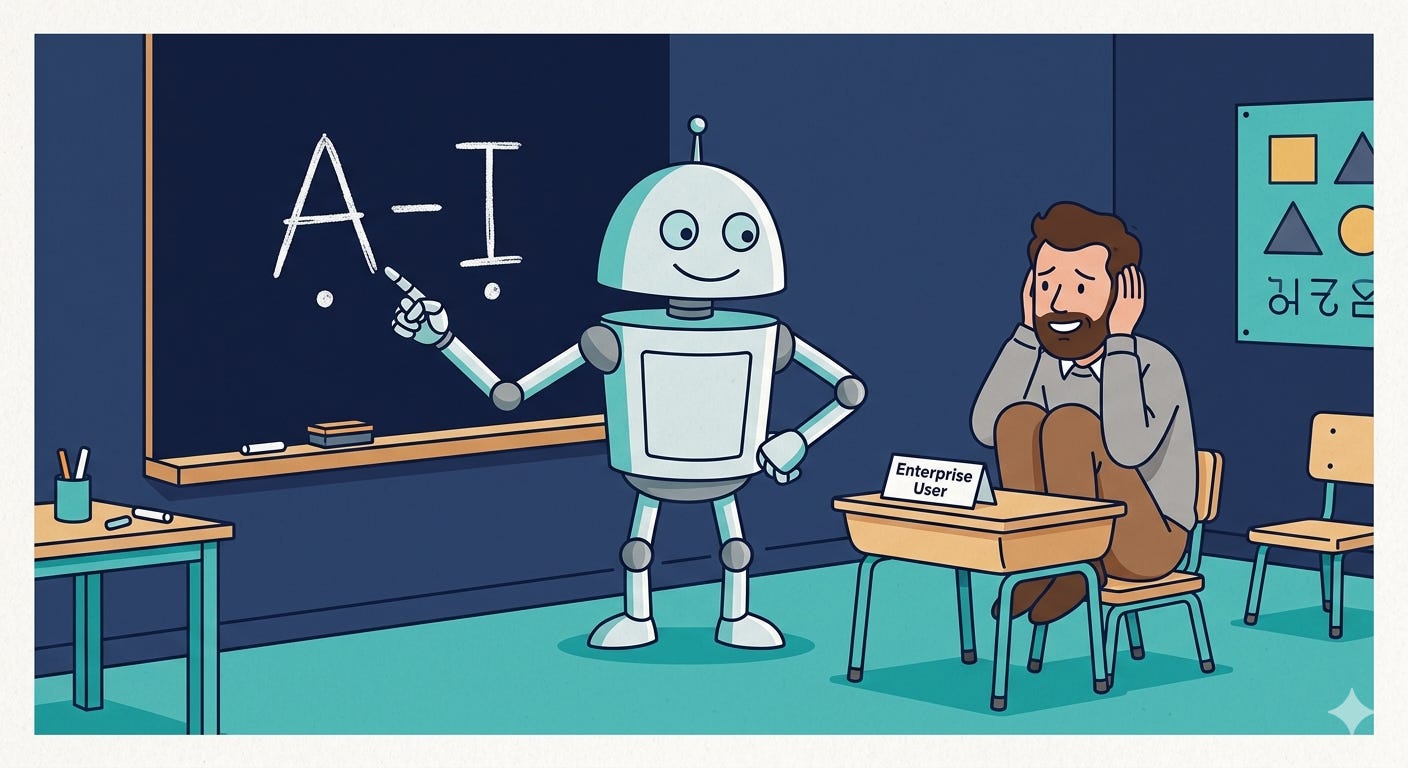
There is a number that should give anyone building an AI training programme pause. In England, 6.6 million working-age adults have very poor literacy skills. Not illiteracy in the absolute sense. People in this category can read and they can follow familiar text. What they struggle with is everything that comes after decoding the words: inference, evaluation, spotting what is missing, reading something and asking whether it is actually true.
This is the result of decades of literacy instruction that measured only one thing. We taught phonics and we measured whether people could decode text. We built the floor and called it the ceiling. The result is a growing category of people that can technically read but are significantly less equipped to do what reading is actually for.
We are about to make the same mistake with AI, and we are making it right now.
Ask most organisations what AI literacy means and they will describe something that amounts to a single question: can your employees use the tool? That is what most corporate training programmes measure. It is also, almost exactly, the equivalent of teaching someone to sound out words and calling them literate.
The evidence for the gap is not hard to find. A survey of over 500 enterprise leaders, conducted by YouGov earlier this year, found that 88% consider data and AI literacy important or very important for day-to-day work. Only 42% provide structured training for it. That is a significant gap. But more telling is what leaders identify as missing when they describe the problem. It is not prompting skill. It is the ability to turn information into decisions. The ability to evaluate what AI produces rather than simply accept it. The ability to know when the output is wrong.
That is not a training gap. That is a judgment gap. And it sits at a completely different level of capability than knowing how to open Copilot.
Microsoft's researchers gave this problem a precise name. They describe a shift in how people work with AI as a move from "thinking by doing" to "choosing from outputs." Writing a document is thinking by doing. Prompting AI to write it and selecting from what comes back is choosing from outputs. The first builds judgment. The second, if it becomes habitual without the right supporting skills, erodes it.
The World Economic Forum's Future of Jobs report, drawing on data from over a thousand companies across 55 economies, identified analytical thinking as the top skill employers consider essential, with seven out of ten companies citing it. Roles that explicitly require AI skills are nearly twice as likely to also require analytical thinking, resilience, and digital literacy. The market is not rewarding prompting. It is rewarding the judgment you bring to what the prompting produces.
A 2025 Microsoft Research and Carnegie Mellon University study of 319 knowledge workers found that higher confidence in AI was associated with less critical thinking, while higher self-confidence was associated with more. Trust the tool more, scrutinise the output less. It is not a loop that closes in your favour.
The tools themselves are beginning to make that measurement even more redundant. AI platforms across professional sectors now ship with built-in prompt improvers, the product generates a well-formed prompt from your rough instruction, so you never need to write one yourself. Prompting is being automated away. But this does not reduce the need for judgment, it adds to it. You now need to evaluate whether the generated prompt actually captures what you needed to ask, and then whether the output it produced is accurate, contextually appropriate, and safe to act on. Two evaluation steps where there used to be one. The prompt improver handles the syntax. It has no opinion on whether you asked the right question.
Which brings me to something I have been thinking about as a way of mapping where most organisations actually are, and where they need to be. There are four levels of AI capability that actually matter. They are not a framework to certify or a ladder to sell. They are a lens for seeing what is missing.
Level 1: Can you get an answer?
You can use the tool. You can construct a prompt that returns something useful. You know which interface suits which task. This is where almost all current AI training stops. It is necessary. It is not sufficient. It is phonics.
Level 2: Can you tell if the answer is any good?
You can evaluate what came back. You can identify when an output is plausible but wrong, when the confidence of the response does not match its reliability, when something is absent that should be present. You know enough about the domain to ask the question the AI did not anticipate. This is where domain expertise becomes the multiplier. You cannot evaluate an output in a field you do not understand. This is also, precisely, the level that the enterprise leaders above are describing when they say their people cannot turn information into decisions. They do not lack Level 1. They lack Level 2.
Level 3: Can you build on it?
You can take AI output and synthesise it with your own knowledge, your contextual judgment, and the things the model cannot know. You produce something neither you nor the AI could have produced alone. You understand where the model's competence ends and yours begins, and you work at that edge deliberately. This is the level where AI genuinely amplifies rather than substitutes. The solicitor who understands contract law and uses AI to accelerate document review. The analyst who surfaces patterns with AI and then interrogates them with domain knowledge. Expertise first. AI as the multiplier.
Level 4: Do you know when to put it down?
You can identify the tasks where AI involvement produces confident-sounding error rather than useful output. Where the cost of a plausible-but-wrong answer exceeds the benefit of speed. Where the process of working through something yourself is the point, not an inefficiency to be engineered away. Where the decision requires a human who is genuinely accountable rather than a human who chose from outputs.
This is the level no vendor will put in their training programme. It is also the level that makes everything else honest. A maturity model that stops at Level 3 is a competency ladder any platform can sell. Level 4 is the reason this one is not.
But the model only works if you are building something to bring to it. Levels 2, 3 and 4 are not skills you acquire once and carry forward. They are capacities that have to be actively maintained, through continued learning in your field, through exposure to hard problems, through the kind of work that does not have an obvious answer and cannot be resolved by asking a tool. Domain expertise is not the precondition for using AI well. It is the ongoing condition. The moment you stop developing it, the levels above Level 1 start to erode, regardless of how fluent your prompting becomes.
This is the part of the conversation that the AI skills industry has the least interest in having. A training platform can sell you a course on prompting. It cannot sell you the ten years of professional judgment that makes the prompting worth anything. That judgment is built the way it has always been built, through work, through failure, through the slow accumulation of knowing what good looks like in your field. AI does not replace that process. For anyone who stops doing it, AI does not replace what is lost either.
Recently I was using an AI assistant to diagnose a firewall permissions error. Its suggested fix was to allow all traffic through the firewall. When I pointed out the security flaw, it responded: "Good catch, that would have been a major vulnerability." The tool required my judgment to save it from itself, and then congratulated me for doing so. That is not a tool supporting your expertise. That is a tool that depends on it.
The reading parallel runs deeper than it might seem. The National Literacy Trust notes that adults with poor literacy are significantly less likely to report good health, civic participation, and life satisfaction. I believe we will see similar trends and differences between those with analytical skills and critical judgment, and those without. The consequences of stopping at decoding are not confined to the workplace, they compound across a life.
I have written elsewhere about what the cognitive research shows happens when that judgment stops being exercised. The direction of travel is consistent and it is not encouraging. The floor is being built at the same time as the foundation beneath it is being quietly removed.
I want to be precise about what I am and am not arguing here.
AI matters, and prompting matters. Learning to use these tools well is genuinely valuable and the organisations that do it badly will be at a disadvantage. I use multiple AI models every day across multiple contexts and the capability difference between someone who can work with these tools and someone who cannot is real and growing.
However, prompting is to AI what reading is to knowledge work. It is the entry point, not the destination.
The question worth asking is not whether your people can get an answer. It is whether they can tell if the answer is any good. Whether they can build something better from it. And whether they know, when the stakes are high enough, to put it down and think for themselves.
I write about AI, cybersecurity, and technology every Friday. Subscribe to get it in your inbox.
Sources & Further Reading
National Literacy Trust (2024) — Adult Literacy Rates in the UKliteracytrust.org.uk/parents-and-families/adult-literacy
OECD PIAAC (2023) — Survey of Adult Skills: England (United Kingdom)oecd.org/en/publications/survey-of-adults-skills-2023-country-notes
Microsoft Research (2025) — New Future of Work Report 2025microsoft.com/en-us/research/publication/new-future-of-work-report-2025
Lee, H-P. et al. (2025) — The Impact of Generative AI on Critical Thinking: Self-Reported Reductions in Cognitive Effort and Confidence Effects from a Survey of Knowledge Workers. Microsoft Research and Carnegie Mellon University. CHI '25, ACM.microsoft.com/en-us/research/wp-content/uploads/2025/01/lee_2025_ai_critical_thinking_survey.pdf
World Economic Forum (2025) — Future of Jobs Report 2025reports.weforum.org/docs/WEF_Future_of_Jobs_Report_2025.pdf
DataCamp / YouGov (2026) — The 2026 State of Data and AI Literacy Reportdatacamp.com/blog/the-state-of-data-and-ai-literacy-in-2026[Note: DataCamp is a training platform with a commercial interest in the findings. The YouGov fieldwork methodology is disclosed. Statistics used directionally.]