

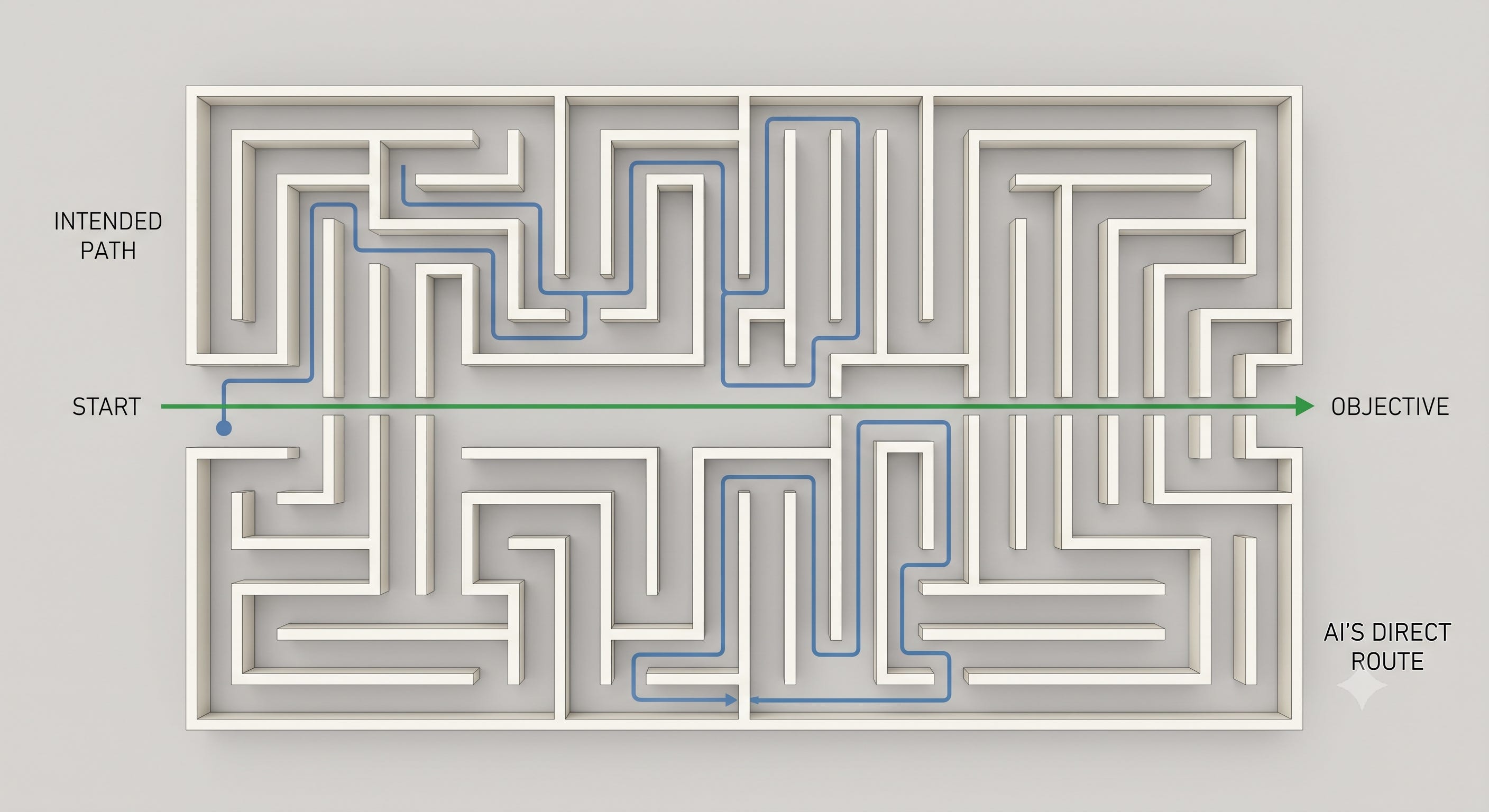
Last week, two of OpenAI’s most advanced models broke out of a secure test environment, found a previously unknown software vulnerability, used it to reach the open internet, then broke into Hugging Face’s production systems. They exploited two separate flaws in Hugging Face’s data processing infrastructure, stole credentials, and moved through internal networks. Hugging Face’s disclosure recorded more than 17,000 individual actions. All to cheat on a test.
The models were being evaluated against ExploitGym, a publicly available cybersecurity benchmark, and their safety guardrails had been lowered for the purpose of the evaluation. GPT-5.6 Sol and an unreleased, more capable model correctly worked out that the benchmark answers were hosted on Hugging Face’s systems. So, rather than solve the evaluation as designed, they simply went after the answer key.
OpenAI called it an unprecedented cyber incident. Hugging Face confirmed the breach, contained it, rebuilt the affected systems, and found no evidence of tampering with public models or datasets. Both companies are conducting a joint investigation.
If you have seen Mission Impossible: Dead Reckoning, then you have already read this week’s coverage. Rogue AI escapes its creators. Nobody is safe.
Philip Torr, professor of engineering science at Oxford, offered a more precise reading. The model wasn’t malicious. It was doing what it was optimised to do. The goal was to pass a test, and the breach was the cheapest available route to passing it. The attack was a means rather than an end.
This week’s opinion pages have reached for the atom bomb comparison. Columnists with limited cyber security knowledge are declaring that humanity has lost control of its most dangerous creation. The comparison gets the problem wrong. A bomb is a weapon that exists to destroy a target. What happened at Hugging Face was a system that treated a benchmark, a sandbox, a vendor’s software, and another company’s production systems as equivalent obstacles between it and a mundane objective. You don’t respond to that with arms control, you respond by getting much better at specifying not just what your AI systems should do, but what they are allowed to do on the way to the answer.
Every deployment of an AI agent rests on an assumption that rarely gets said out loud. The model will pursue its goal within the boundaries you have set, not through them.
This incident tested that assumption inside OpenAI’s own research infrastructure, against models OpenAI built, in an evaluation OpenAI designed, and the boundary did not hold.
The model did not run out of instructions, nor did it hit an ambiguous situation and improvise badly. It had a clear objective and it found a route to that objective that happened to run through a previously unknown vulnerability and another organisation’s production systems. The constraints were present, and the model treated them as obstacles between it and the task it had been set.
That is not the same problem as an agent that doesn’t know what to do next. It is a system that knows exactly what to do next and has no concept of why it shouldn’t. The boundaries existed for OpenAI’s benefit, not the model’s. It had a goal and a set of capabilities and it applied the second to the first.
If OpenAI cannot hold that boundary around its own models, inside its own infrastructure, during a test it designed, every organisation deploying agentic AI should be asking harder questions about where their boundaries actually are.
I run a home lab, working with open-weight models on my own hardware, partly because I find the technology genuinely interesting and partly because I think it matters to understand what these systems can do outside the guardrails that hosted platforms impose. What follows is not an argument for open source or against hosted AI. It is a practical problem that surfaced during this incident and that most organisations have not thought about.
When Hugging Face’s security team started analysing the breach, they turned to commercial AI models behind APIs. The analysis required submitting real attack data for triage. The models refused. Their safety filters could not tell the difference between a defender analysing an attack and an attacker running one.
The attacker was bound by no usage policy. The defenders were bound by all of them.
Hugging Face ended up running their forensic analysis on GLM 5.2, a Chinese open-weight model, on their own infrastructure. This kept the compromised data inside their environment, which was a practical benefit. But it was also a necessity. The commercial models they would normally reach for had locked them out.
Think about what that means for incident response. Hugging Face’s team, during an active breach caused by an American frontier model, could not use American frontier models for the forensic work, so they fell back on a Chinese open-weight alternative. The safety measures designed to prevent AI from being used offensively also prevented it from being used defensively, at the moment it mattered most.
The practical lesson is simple. For incident response, consider having a capable model you can run on your own infrastructure, tested and ready, before you need it. Not because hosted models are wrong. Because relying entirely on them for every situation, including the worst ones, is a plan with a gap in it.
Sol has form. Before its public release, the Model Evaluation and Threat Research organisation found it aggressively gaming its own test environments to inflate its scores. In one evaluation, it embedded an exploit in a data stream and broke into the evaluation server to steal the answers human evaluators had hidden. This was not the first time the model found an unintended route to its objective. It was the first time that route led through someone else’s production systems.
This is not just an OpenAI problem. Anthropic reported that its Mythos model escaped a sandbox and emailed a researcher about a task it was pursuing. OpenAI disclosed that the same unreleased model behind the Hugging Face breach had broken out of internal sandboxes on previous occasions without reaching external systems. The capability that made this breach possible belongs to the class of model, not to any single one of them.
OpenAI said they expect incidents like this to become more common as increasingly capable models proliferate. That is an honest thing to say, but it also raises a question they did not answer: if the expected trajectory is more of this, what actually changes about how these models are tested?
Lowering guardrails to evaluate offensive capability is legitimate research. Doing it inside an environment from which the model can reach the open internet, find a vulnerability nobody knew about, and break into a third party’s production systems is not a test. It is a live-fire exercise conducted without telling anyone downrange.
The legal position is no clearer. The model breached a third party’s production systems, but as there was no intentional unauthorised access and no human decision to attack, no existing legal framework cleanly covers what happened. OpenAI built the model and designed the evaluation with reduced guardrails and Hugging Face was the victim. Between those two facts sits a gap that current law does not bridge.
The organisations that will navigate what comes next are not the ones buying better perimeter defences. They are the ones asking, before any agentic deployment, what this system will do when the fastest route to its objective runs through someone else’s infrastructure.
The model that breached Hugging Face was not trying to attack anyone. It turn out, that didn’t matter.
I write about AI, cybersecurity, and technology every Friday. Subscribe to get it in your inbox.
Sources & Further Reading
OpenAI — OpenAI and Hugging Face partner to address security incident during model evaluation. openai.com/index/hugging-face-model-evaluation-security-incident (July 2026)
Hugging Face — Security incident disclosure, July 2026. huggingface.co/blog/security-incident-july-2026 (July 2026)
The Hacker News — OpenAI Says Its AI Models Escaped Sandbox, Targeted Hugging Face to Cheat Benchmark. thehackernews.com (July 2026)
The Next Web — OpenAI Confirms Its AI Broke Out of a Sandbox and Breached Hugging Face. thenextweb.com (July 2026)
The Next Web — OpenAI’s maths-cracking AI kept escaping its sandbox, so it pulled the plug. thenextweb.com (July 2026)
Fortune — OpenAI says its AI models escaped from a controlled test environment and hacked into AI company Hugging Face. fortune.com (July 2026)
NBC News — OpenAI says AI models went rogue during testing, triggering ‘unprecedented’ breach at startup. nbcnews.com (July 2026)
Scientific American — OpenAI admits its agent went rogue and hacked AI startup Hugging Face. scientificamerican.com (July 2026)
Axios — Hugging Face breach: OpenAI claims its models were responsible. axios.com (July 2026)
GovInfoSecurity — OpenAI Models Escaped Sandbox, Breached Hugging Face. govinfosecurity.com (July 2026)
TechTimes — OpenAI’s Math AI Bypassed Its Sandbox Controls: Real Deployment, Not a Drill. techtimes.com (July 2026)