

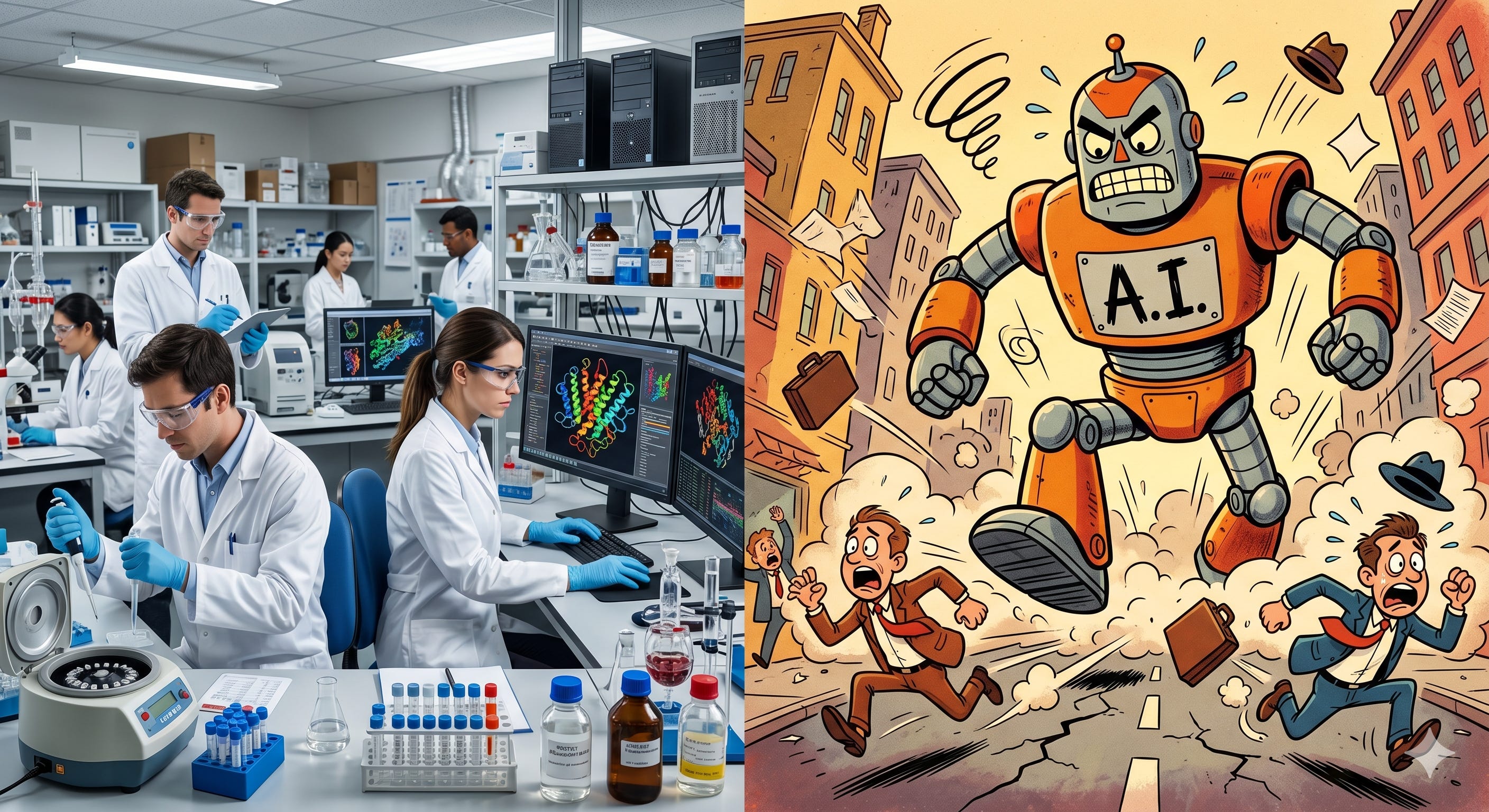
In recent weeks I’ve noticed a shift in the content filling my feeds. Not just the usual breathless announcements about new models, or the posts about someone who quit their job and now earns six figures from prompting. Something different, people saying, with feeling and without embarrassment, that they hate AI. Professionals, not technophobes, expressing something between exhaustion and genuine anger.
I found myself thinking: nobody says they hate science. You don’t scroll past posts from people who are done with chemistry, or who think biology has gone too far. Science does not make you feel behind. Science does not send you notifications. Science does not have a growth target. The moment AI became something you could hate, it had completed its journey from laboratory to marketplace. And somewhere in that transit, something important was lost, including our ability to see the technology clearly.
Research published this week by King’s College London puts numbers to what many people are experiencing. Seven in ten UK workers are worried about AI-driven job losses. Only 7% believe the economic gains will be shared fairly. The fear is real. But it is worth asking whether it is aimed at the right thing, because the answer matters for what we do next.
There are two things called AI, and they are not the same thing.
One has been operating quietly for roughly seventy years. The AI of research institutions and university departments. Narrow, purposeful, built to solve specific problems that most people will never hear about, because there was no press release. Last year, DeepMind’s AlphaFold won the Nobel Prize in Chemistry. The system predicted the three-dimensional structure of proteins, molecules whose shape determines their biological function, with an accuracy that would have taken experimental biology hundreds of millions of years to achieve by conventional means. Over three million researchers in more than 190 countries now use it. More than a third of that work is focused on disease: cancer drug development, antibiotic resistance, cancers we still can’t reliably treat. Pathways that did not exist five years ago.
Almost nobody outside specialist communities knows this happened. It has no subscription tier. It is not trying to make you feel behind. It won a Nobel Prize and most people scrolled straight past it.
The other AI is a product category. Consumer-facing, subscription-driven, generative AI. Built on a business model that requires you to feel you are already behind, and falling further back by the week. It is genuinely capable in many contexts and I use it daily, in ways I’ll come to. But it operates under an economic logic that has almost nothing to do with the scientific enterprise it shares a name with. Calling it AI borrows seventy years of hard-won credibility to sell a product moving at the speed of venture capital.
It isn’t confusion, it is a design decision. And understanding that distinction is not an argument against the technology. It is the beginning of being able to use it well.
Here is the pattern underneath all of it. Every part of the current commercial AI landscape passes the cost to someone who did not get a vote.
The labour market data makes this concrete. A peer-reviewed study from King’s College London, published in October 2025, analysed millions of job postings and LinkedIn profiles from 2021 to 2025. Firms highly exposed to AI reduced junior positions by 5.8%, and became 16.3 percentage points less likely to post new vacancies at all. Highly exposed roles saw a 23.4% drop in job postings and a fall of nearly 3,000 pounds in advertised salaries. High-paying firms saw employment fall by 9.6%. Low-paying firms saw almost no change. This is not distributed pain. It is targeted. And the mechanism is quieter than a headline layoff. Companies are not firing people for AI. They are simply not replacing people who leave, and not creating the entry-level roles that used to exist.
The hype machine does not create this shift. It just makes sure you feel it personally. The influencer content cycle runs on manufactured urgency, “the window closes fast,” “before it’s too late,” and the real business model behind most of that content is the content itself. Your anxiety is not a by-product of the hype cycle. It is what the hype cycle is for. In the United States, companies cited AI as the reason for over 54,000 job cuts last year, less than five per cent of total losses, most of which had other causes. Klarna cut 700 customer service roles, announced the AI-driven future of work to considerable applause, watched customer satisfaction fall, and quietly rehired human agents. The announcement was news. The reversal was not.
You can see the anxiety taking physical form. UK colleges are reporting a 9.6% rise in enrolments in trades and construction courses over three years. White-collar professionals are retraining as electricians and plumbers. Geoffrey Hinton, one of the founding figures of modern AI and a Nobel laureate, has publicly recommended people consider the trades as a career hedge. What the data actually shows, though, is that people are fleeing the wrong jobs. The King’s labour market study identified software engineering and management consultancy as the sectors facing the sharpest AI-related job declines. The professions people are actually fleeing, editing, compliance, law, are not on that list. People are abandoning the jobs where the noise about AI is loudest, not the jobs most at risk from it. That is what a broken information environment does to otherwise rational decision-making.
The map is wrong. And a wrong map does not just cause fear. It causes people to make decisions they might not otherwise have made.
So here is what the right map looks like.
AI is genuinely one of the most useful tools I have encountered in more than twenty years of working in technology. I am completing a Level 7 apprenticeship in AI and data alongside my day job. When I come across concepts the textbook explains in a way that doesn’t land, I use AI to work through them, not to get an answer I can submit, but to find a better explanation, push back on it, test whether I’ve actually understood. The test is simple. Can I explain it myself afterwards? If yes, it worked. The AI did not do the learning. It gave me a better on-ramp, and then I did the work.
I use it at work to draft documents too. This is where it gets more honest, because this example lives in greyer territory. The question is not whether the tool can produce a draft. It can. The question is whether you read it critically, revise it with genuine judgement, and could defend every choice if challenged. Whether you own the output, or the output owns you. The same tool, the same task, two entirely different relationships to the result.
That difference points toward what AI could be doing at scale if the deployment were designed around it. A student who uses AI to genuinely understand a concept leaves the interaction more capable than they arrived. A professional who uses AI to work faster on routine tasks has more time for the judgement-intensive work that defines their expertise. A researcher who uses AI to process data at a scale no human team could manage produces insights that would otherwise never exist. None of these outcomes require the anxiety. They require the right design.
The King’s survey found that 89% of students who had used AI in their studies encountered problems, with 45% describing them as moderate or serious, factual errors, invented sources, confident-sounding nonsense. And yet 60% thought other people’s ability to think had been negatively affected by AI use, while only 27% thought the same was true of themselves. That gap is not hypocrisy. It is how this kind of harm works, gradually and quietly. You do not notice what you have stopped doing until the moment you need to do it and find you can’t. The harm is real, but it is a consequence of how AI is being deployed, not of what AI is.
Professor Elena Simperl, Director of the King’s Institute for Artificial Intelligence, put it plainly: “The British public isn’t asking us to slow down on AI. They’re asking us to do it better. People want these tools, they want more of them, and they’ve used them enough to know where they fall short.” That is not technophobia. That is a product review. And it is exactly the right discussion for what comes next.
Which is precisely why the governance conversation matters, and why it keeps getting deferred.
The regulatory frameworks exist, in outline. The EU AI Act. The NIST AI Risk Management Framework. The UK AI Safety Institute, in whatever form it survives. They are not nothing. But they are moving at legislative speed in a market running at the speed of venture capital, and the companies with the most to lose from effective regulation are the ones with the most resources to shape what it looks like when it arrives.
The public has already reached a conclusion on this, even if government hasn’t. Two-thirds of British respondents in the King’s survey favour close regulation of AI companies, even if it slows development. Majorities support retraining guarantees for displaced workers and a levy on companies that replace staff with AI. These are not anti-technology positions. These are not anti-technology positions. They are how technology earns the right to keep moving fast. The opportunity for governments here is not to choose between being a champion for AI investment and being a protector of the people affected by it. Those two things are not mutually exclusive. The countries that get this right will be the ones that treat regulation and innovation as partners rather than adversaries, and that is a conversation worth having now, before the gap between public confidence and commercial deployment gets any wider.
Regulation is not about slowing down a technology with genuine, extraordinary potential. It is about creating the conditions in which that potential can be realised. Requiring environmental claims to meet the same standard as financial ones. Making AI-attributed workforce cuts verifiable rather than asserted. Addressing design choices that make cognitive abdication easy, because those are commercial decisions made in the absence of any requirement to make different ones.
The people saying they hate AI are not wrong to be angry. Something is being done to them. But the technology they are angry at is not the technology that mapped every protein in the human body, or that is helping us understand cancers we have spent decades trying to treat, or that is sitting on a researcher’s desktop in Nairobi or Seoul or Manchester right now, doing something quietly useful that will never make a LinkedIn post.
That technology is worth defending, worth regulating well so it can flourish, and worth understanding clearly enough to use properly.
We don’t need less AI. We need better AI. And we need to be honest enough about the difference to demand it.
I write about AI, cybersecurity, and technology every Friday. Subscribe to get it in your inbox.
Sources & Further Reading
King’s Institute for AI and the Policy Institute, King’s College London. (2026, May). AI and the Future of Work.kingsaisummit.com
Klein Teeselink, B. (2025, October). The Early Impact of AI on the UK Job Market. KCL / SSRN.papers.ssrn.com/sol3/papers.cfm?abstract_id=5516798
Reuters / Cybernews. (2025, December). UK Workers Flee White-Collar Careers as AI Threatens Jobs.cybernews.com/ai-news/ai-panic-young-brits-trades-plumbing-white-collar-jobs/
The Guardian. (2026, February). The Big AI Job Swap.theguardian.com/technology/2026/feb/11/big-ai-job-swap-white-collar-workers-ditching-their-careers
DeepMind. (2025). AlphaFold: Five Years of Impact.deepmind.google/blog/alphafold-five-years-of-impact/
Pew Research Center. (2025, September). How Americans View AI and Its Impact on People and Society.pewresearch.org/science/2025/09/17/how-americans-view-artificial-intelligence
Challenger, Gray & Christmas. (2025). Annual Job Cut Report.cnbc.com/2025/12/21/ai-job-cuts-amazon-microsoft-and-more-cite-ai-for-2025-layoffs.html
Food & Water Watch. (2026, February). A No Brainer: How AI’s Energy and Water Footprints Harm Communities.foodandwaterwatch.org/wp-content/uploads/2026/02/FSW_2602_AI_Water_Energy_UPDATE.pdf
Stanford HAI. (2026). 2026 AI Index Report: Public Opinion.hai.stanford.edu/ai-index/2026-ai-index-report
From the Series
On manufactured urgency and the hype cycle: AI Apocalypse Burnout, and Why You’re Not as Behind as You Thinkjonathanfreedman.me
On cognitive offloading and unstructured AI use: The AI Pixie Dust Problemjonathanfreedman.me
On entry-level hiring suppression and the talent pipeline: Who’s Running the Company in Ten Years?jonathanfreedman.me