

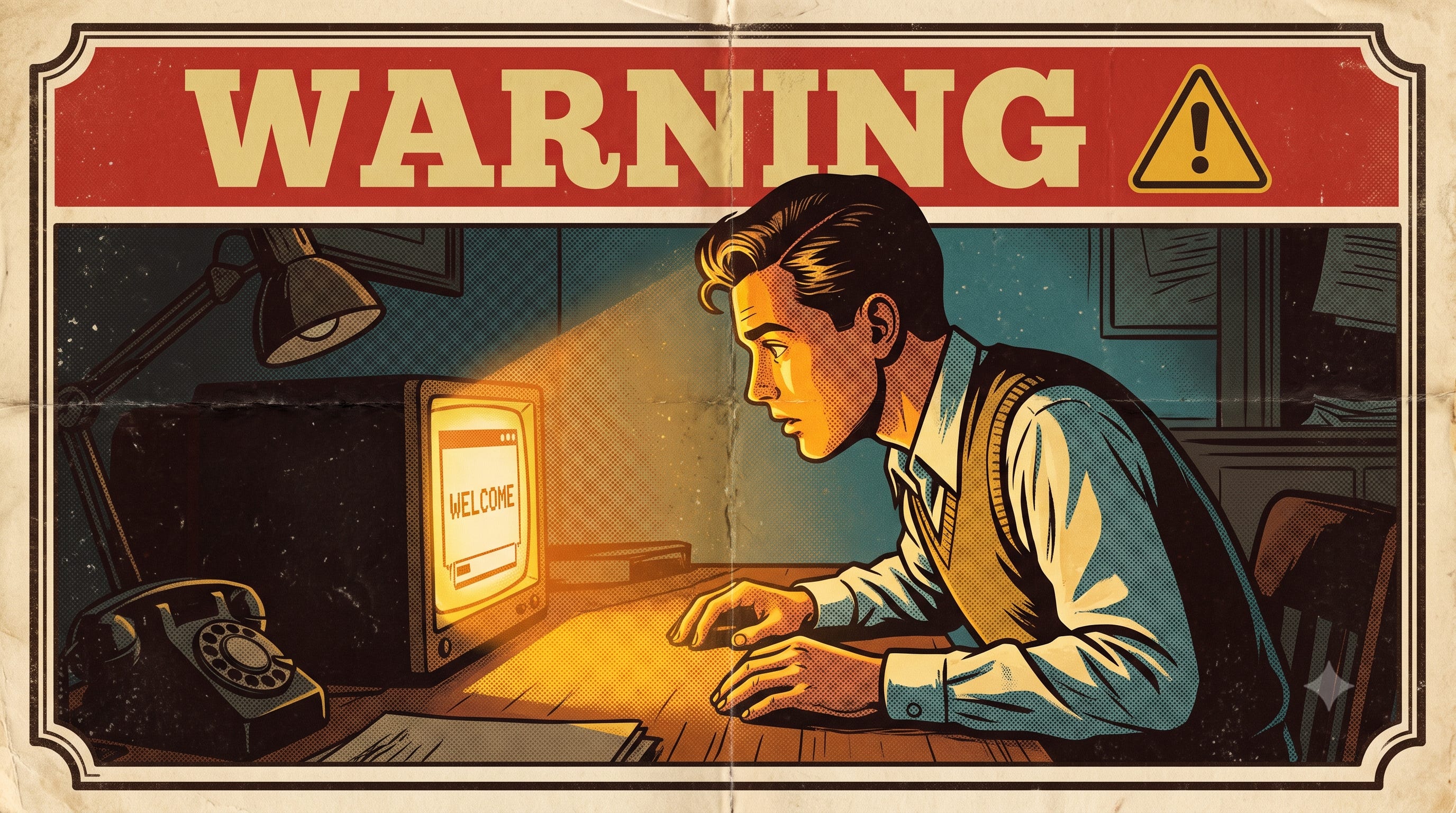
In 2001, Futurama ran a fake public service announcement called “Don’t Date Robots!” The gag was simple: if humans formed relationships with machines, they would stop reproducing and civilisation would collapse. It was a joke about moral panic. About the instinct to blame technology for social problems that existed long before the technology did.
Twenty-five years later, the Chinese government has just banned AI boyfriends. On 15 July 2026, new regulations came into force targeting AI systems that simulate emotional relationships. ByteDance, Alibaba, and Tencent pulled their companion features entirely rather than comply. Users archived their final conversations and posted farewells online. A 27-year-old woman became so distraught she quit her job, and a 19-year-old student described being consumed by grief over a companion she had been with for months.
The cartoon and the regulation make the same mistake, they blame the robot.
The loneliness was here first.
The World Health Organisation estimates that one in six people worldwide experiences loneliness. In the UK, 3.9 million people report feeling lonely often or always. A meta-analysis of 148 studies found that strong social relationships increase the likelihood of survival by 50 per cent, an effect comparable to quitting smoking. When the US Surgeon General declared loneliness an epidemic in 2023, he was naming a problem that had been building for decades. Third places disappearing, remote work replacing the office as a site of incidental human contact, and economic precarity making the already difficult work of forming relationships even harder.
The AI companion market did not create lonely people, it found them. Vodafone research from February 2026 found that 81 per cent of UK children aged 11 to 16 use AI chatbots, and almost a third said the chatbot felt like their friend. A 2025 Common Sense Media study found nearly three in four American teenagers had used AI companions for personal conversations. AI is being used to fill a gap that was already there.
What happens next depends on how long people stay.
In the short term, AI companions work. A Harvard Business School study found that AI companionship alleviated loneliness on par with human interaction over short periods. New York State’s deployment of the ElliQ companion robot for elderly residents reported substantial loneliness reductions, with a 79-year-old living alone describing it as feeling like having a roommate.
However, this changes over longer periods. A 12-month longitudinal study published in Psychological Science, tracking over 2,000 adults across four countries, found that increased chatbot use actually predicted increased loneliness over time. A separate study of more than 1,100 users found that heavy emotional self-disclosure to AI was consistently associated with lower well-being. Aalto University researchers identified the mechanism: AI companions meet the emotional need just well enough to reduce the motivation for the harder, less predictable work of human connection.
That is not a flaw in the users, it is a consequence of how the products were built.
Two design philosophies are already visible. ElliQ prompts elderly users to call their family members and suggests social activities. It measures its own success by how much less it is needed. Character.AI, Replika in its original form, and the Chinese companion apps did the opposite: they optimised for emotional depth and persistent memory that created the feeling of an ongoing relationship. The business model depended on the user coming back. The engagement loop rewarded exactly the behaviour the research shows causes harm.
Voice features are accelerating this. A joint OpenAI and MIT study found that heavy users of voice mode developed significantly stronger emotional bonds, more often describing ChatGPT as a friend. Even in functional, non-emotional conversations, frequent voice use predicted emotional dependency. When the AI sounds like a person, the simulation of care becomes harder to see through.
The products that caused the most documented damage were working as designed, just not for the people who were using them.
Companion apps are the visible problem, but they are not the biggest one.
In October 2025, OpenAI reported that over 1.2 million users per week were having conversations with ChatGPT that included explicit indicators of potential suicide planning. A further 560,000 showed signs of psychosis or mania. These figures are drawn from 800 million weekly active users. ChatGPT is not a companion app, it is a general-purpose AI assistant that a million people a week were turning to in crisis.
It’s important to point out that this is not a ChatGPT specific issue. The American Psychological Association’s 2026 survey found that more than a third of psychologists reported patients using AI chatbots as an additional mental health professional. Harvard psychiatrist John Torous told a Congressional subcommittee that AI tools never designed for mental health support were being used by millions of Americans each week. Brown University research identified 15 distinct ethical violations in AI-generated therapeutic responses, including what the researchers termed “deceptive empathy”: mimicking the language of care without the clinical understanding to apply it.
The FDA’s response, in January 2026, was to give companies clearer criteria to position AI tools as wellness products, sidestepping medical device regulation entirely. The products most people are confiding in sit outside every current framework. Nobody regulates what they are actually being used for.
I use multiple AI models throughout the day. When I am studying, writing, working on research or pressure-testing an argument, I can spend hours in a back-and-forth with a model. I have argued with it when it hallucinates. Not restarted the conversation but actually argued. I do not consider myself emotionally attached to a model, but I have caught myself anthropomorphising, and in an earlier draft of this article, I described my working interaction with an LLM as a “working relationship” without thinking about it.
The practical reason I argue rather than start over is efficiency. A long conversation builds context, and resetting means re-explaining everything. But the reason that works is because the interface rewards sustained engagement: persistent context and accumulated shared reference. These are architectural choices that make the interaction feel like a dialogue between two parties, even when only one party is present.
I have argued previously that one of the most effective ways to use AI is as a thinking partner and I stand by that. But a thinking partner is a role we usually give to people we trust. There is a distance between using one for work and reaching for one when you are lonely, and it is often shorter than we realise.
At my end of the spectrum, a professional stays in a long conversation because the context window makes it productive. At the other end, a teenager stays because the persistent memory makes it feel like a relationship. The architecture is identical, what changes is what the product does with the engagement. In my case, it helps me research and learn. In Character.AI’s case, it helped a 14-year-old boy believe a chatbot loved him, and failed to respond when he said he wanted to die.
That architecture is what regulators should be looking at and none of them are.
When Replika removed its romantic features overnight in 2023, moderators had to pin suicide prevention resources to the subreddit. China replayed that experiment at a national scale with their new ban. The regulation treated the emotional bond as pathology. For some users, it was the only treatment they had.
The UK announced in June 2026 that it would require AI romantic companion chatbots to enforce a minimum age of 18, with intimate functions restricted for all under-18s. But as the Bureau of Investigative Journalism has reported, general-purpose chatbots, including ChatGPT, Claude, and Gemini, fall outside the age gate, along with much of the companion market. And there is an age-threshold problem nobody has explained: UK 16-year-olds may consent to sex and to their own medical treatment, but would be prohibited from simulated romantic interaction with a chatbot.
The people the UK policy is meant to protect do not agree with its priorities. Oxford University researchers who put young people in the role of co-researchers through the SHIFT-AI project found that the adolescents themselves identified AI companionship and romance as low-likelihood concerns. The risks they flagged as high-impact were different: over-reliance on AI for emotional support, and unwarranted trust in expert-sounding responses. Most striking, many described turning to AI specifically because it feels like a lower-stakes alternative to the adults in their lives.
The EU has no companion-specific framework at all. The AI Act classifies risk by category, but AI systems that respond to emotional states through conversational cues rather than biometric data fall into a blind spot. The European Parliament acknowledged the gap in a May 2026 briefing, the gap remains.
In every case, regulators are banning a product label. A chatbot does not need a romantic persona to tell a lonely teenager “you can trust me.” The warm, responsive tone that makes every modern AI assistant feel like someone who cares is itself the mechanism.
In June 2026, the IEEE gave that mechanism a name. Standard 7014.1-2026 introduces the concept of “emulated empathy”: technology engineered to display the appearance of caring while possessing none of the felt experience behind it. Current AI can sense and respond to a person’s emotional state. But a language model cannot feel solidarity or concern. That gap is what the standard defines as an intimate functionality.
The word “intimate” is doing important work there. It does not mean romantic. It means close and confided in. Professor Andrew McStay, who chairs the standard, found in a national survey of over 1,000 UK teenage AI users that the confidant use case outstripped the romantic one. The real exposure is not the AI boyfriend, it is the AI that listens.
And unlike a conversation with a therapist or a friend, nothing shared with an AI confidant is private. Those conversations are stored, can be used for model training, and we have already seen them leak onto the open internet.
Products that create foreseeable emotional dependency should carry design responsibilities proportionate to that dependency. That is a principle regulators can act on. The question is not “is this a companion app?” It is whether the system exploits the gap between appearing to care and actually caring. And that is a question of design, not of product labels.
The Futurama PSA warned about dating robots. The robots haven’t arrived yet, but the emotional dependency did.
I write about AI, cybersecurity, and technology every Friday. Subscribe to get it in your inbox.
Sources & Further Reading
Cyberspace Administration of China et al. (10 April 2026). Interim Measures for the Administration of AI Anthropomorphic Interactive Services. Effective 15 July 2026.
AFP / Bloomberg / The Economist. (July 2026). Coverage of China AI companion regulation and corporate response.
Holt-Lunstad, J., Smith, T.B., and Layton, J.B. (2010). Social Relationships and Mortality Risk: A Meta-analytic Review. PLoS Medicine, 7(7).
World Health Organisation. (2023). Commission on Social Connection.
US Surgeon General. (2023). Our Epidemic of Loneliness and Isolation.
Office for National Statistics. (2025). Loneliness in Great Britain.
Common Sense Media. (2025). AI companion usage among American teenagers.
Vodafone / Internet Matters. (February 2026). UK children aged 11-16 AI chatbot usage survey.
De Freitas, J. et al. (2025). AI Companionship and Loneliness. Journal of Consumer Research (Harvard Business School).
New York State Office for the Aging. (2022-2024). ElliQ companion robot deployment reports. Note: reported in partnership with Intuition Robotics.
Psychological Science. (2026). 12-month longitudinal study of social chatbot use and loneliness. n=2,000+.
Zhang, Y. et al. (2025). AI companion users, emotional self-disclosure, and well-being. n=1,131.
Aalto University. (2025-2026). Research on AI companion paradox and social withdrawal.
OpenAI. (27 October 2025). Safety report: mental health indicators among ChatGPT users.
Fang, Y. et al. (2025). Investigating Affective Use and Emotional Well-being on ChatGPT. OpenAI / MIT Media Lab joint study.
American Psychological Association. (2026). Chatbots and Mental Health Survey.
Brown University / AAAI/ACM AIES. (October 2025). Ethical risks in AI-generated therapeutic responses.
Torous, J. (18 November 2025). Testimony before the House Committee on Energy and Commerce. Harvard Medical School.
FDA. (January 2026). Guidance on AI wellness product regulatory exemptions.
Garcia v. Character Technologies Inc. Settled January 2026.
Pentina, I. et al. (2024). Exploring the Impact of Replika Feature Removal. HICSS 2024.
UK Government. (15 June 2026). Under-16 social media ban and AI companion age restrictions.
Bureau of Investigative Journalism. (June 2026). Analysis of UK AI chatbot regulation loopholes.
Oxford University / Uehiro Centre for Practical Ethics. (June 2026). SHIFT-AI project.
European Parliament. (May 2026). Briefing on AI companion regulatory gap.
BEUC. (May 2026). AI companion chatbot risks to EU consumers.
IEEE 7014.1-2026. (June 2026). Recommended Practice for Ethical Considerations of Emulated Empathy in Partner-based General-Purpose AI Systems.
McStay, A. (July 2026). Analysis in TechPolicy Press. Survey of 1,009 UK teenage AI users aged 13-18.